Thursday, March 21, 2013

Billbergia 'El Jefe'

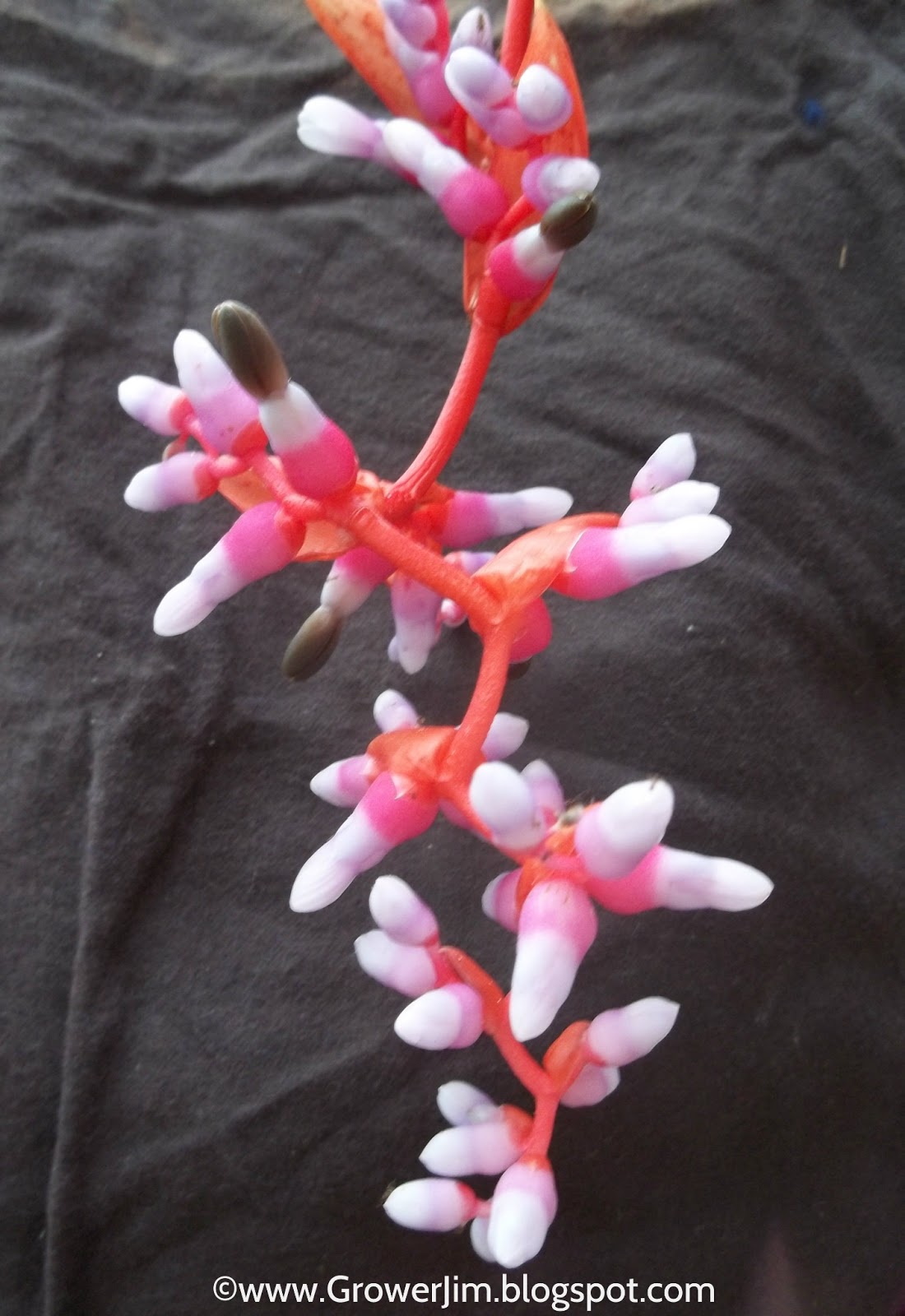
Billbergia 'El Jefe' is a nice medium-sized hybrid that usually blooms in late winter for me. When shade-grown, the plant has a rich chocolate-brown color with white spots.
In higher light the foliage takes on a more pinkish cast. The plant grows about 12-18" tall with an arching inflorescence.
The petals of the flowers mimic the sepals; both are pale-colored with a blue tip.
They are a nice contrast to the showy red bracts on the scape.
After the flowers decline the sepals turn pink, extending the colorful life of the inflorescence.

Thursday, February 28, 2013

Aechmea organensis

Aechmea organensis is a compact-growing species suitable for small places. The plant reaches an overall height and spread of about 8 inches.
Blooming usually occurs in winter, when a red spike with intense blue flowers rises above the foliage. The inflorescence arches away from the center of the plant. The flowering only lasts for a couple of weeks, but the red spike will last a while longer.
Even when not in bloom, the plant is attractive, with distinctly purple leaf bases and tips.
There are other cultivars of this species available that grow larger or smaller, or have pink sepals.

Friday, February 8, 2013

Odontonema callistachyum (purple firespike)


Odontonema callistachyum is a large tropical shrub with showy purple flower spikes all winter long. An inflorescence consisting of scores of tubular flowers develops at the tip of nearly every branch, providing an extended period of bloom. The flower spikes can reach nearly a foot long when fully developed. Hummingbirds and butterflies are attracted to the inch-long blooms if they are in residence at the time of year when flowers are open.
The stems are herbaceous, becoming slightly woody at the base. The plant grows up to 8 feet tall and wide but can be kept pruned to about half that size. The growth habit is somewhat sprawling, so a little trimming back is usually required anyway. Pruning also forces additional branching and therefore more flowers. I usually do a final pruning in late summer so that new growth has a chance to mature before the initiation of flower spikes.
The leaves are large and give a tropical look to the landscape even when the plant is not in bloom. Individual leaves grow up to 8 inches long and nearly as wide.
Odontonema callistachyum is native to Mexico and Central America. It is recommended for USDA Zones 9 to 11. In colder pockets of Zone 9 the flowering season is often cut short by frost or freeze. In these areas it can be grown as a perennial shrub. It will flower in containers, but requires diligent pruning to keep it from becoming tall and lanky.
Flowering is best in full or half-day sun, but the foliage looks best if given a little shade during the summer.
Related reading: Odontonema strictum

Thursday, January 31, 2013

Aechmea weilbachii forma pendula

Aechmea weilbachii forma pendula is one of the few bromeliad species that has truly pendulous flower spikes. Many other species have lax or arching spikes, but these hang straight down far below the crown of the plant. That makes this Aechmea a perfect choice for hanging basket culture.
Aechmea weilbachii comes in three distinct forms and this is the pendulous one. The length of the bloom spike can be more than 2 feet.
Flowering occurs in winter and the inflorescence keeps good color for many weeks. Bracts are a rosy-pink color and flower petals are pale lavender. The bracts become darker as the bloom spike ages.
The leaves are long, narrow and flexible, giving a grass-like appearance to large clumps of the plant. Individual leaves are about an inch wide by 12-18 inches long. They are spineless or have only soft flexible spines near the base, making this a good choice for people who are turned off by more heavily armored species.
Offsets are produced on short, thin stolons.

Related reading: Aechmea weilbachii forma viridisepala

Friday, January 25, 2013

Tetradenia riparia (Iboza)

Tetradenia riparia is a shrubby plant with highly fragrant foliage and spectacular winter flowers. The leaves are thick with a scalloped edge. Glandular hairs cover both sides of the leaf, giving it a sticky feel. They emit a strong scent that remains even when the leaf dries. In its native Africa, the leaves are added to stored seeds and grains to keep out weevils and other injurious pests. There are also many traditional medicinal uses. Simply inhaling the scent of the crushed leaves is supposed to relieve headaches. A tea made from the leaves is used for colds and flu.

In winter the tip of every branch is covered with clusters of snow-white flowers. Even the smallest of plants bloom. I've had them flower in a 4-inch pot with a flower spike taller than the plant itself. The blooming period may extend for more than two months as new buds continue to open at the branch tips. The species is semi-deciduous, depending on the climate, so in some locations the plants will be nearly bare when they come into bloom.
Tetradenia can grow to 8 or 9 feet in height, but is cold-sensitive, and only recommended for USDA Zones 9B-11 when planting in the ground. At 30°F the plant completely defoliates, but will leaf out again from the bare stems. Fortunately, it thrives in containers. In slightly colder zones it may be grown as a perennial (it's supposedly root-hardy to Zone 8), but frost may come before the bloom. Even then, it's still worth growing for the scented foliage and medicinal uses.

The species name, riparia, means growing on the banks of rivers, and that is where the plant is frequently found in its native habitat, as well as in dry wooded valleys and on hillsides. It grows well in full sun, but in hot climates it benefits from a little shade during the middle of the day.

The common name Iboza is a native Zulu word referring to its aromatic qualities, and that name is sometimes seen listed as the genus for the plant. Other common names include misty plume and ginger bush. Cultivars supposedly exist bearing pink or lavender flowers.


Tuesday, January 8, 2013

Aechmea kertesziae

Aechmea kertesziae is a colorful bromeliad that blooms en masse during the short days of winter. The plant grows about a foot tall and 12-18 inches wide. Multiple orange and yellow flower spikes emerge from plant clumps all at the same time making for quite a display.
Foliage is apple-green in color and has minimal spines along the leaf margins. Plants grow well in exposures ranging from full shade to mostly sunny. During the summer the plants look best if they get a little mid-day shade.
In the winter, the plants tolerate brief periods as low as 26°F without damage, as long as no frost forms on the leaf surface.
Buy Aechmea kertesziae plants

Thursday, December 27, 2012

Carissa macrocarpa (natal plum)

Carissa macrocarpa (syn. C. grandiflora) is a very attractive shrub that bears edible fruits. It is sometimes called natal plum, but it is not a plum, belonging instead to the Apocynaceae family.
Very fragrant white blooms appear near the stem tips whenever the plant is in growth. The fragrance doesn't carry far, so it's best enjoyed up close. Individual flower are five-petaled and about 2 inches across. Pollinated flowers are followed by 1-3 inch long reddish fruits.
When the fruit turns dark red, starts to soften, and gives slightly under gentle pressure, it's time to pluck it off and pop it in your mouth. Even fully ripe fruits have a slightly milky sap, but it is undetectable when eaten whole.
Each fruit contains a few small brown seeds that are soft enough to chew or swallow. The chewed seeds do detract somewhat from the cranberry/raspberry/strawberry flavor, so I usually swallow them whole or spit them out.
The plant can be relatively slow growing, but eventually reaches 8 feet. Branching often takes on a layered look, and the stems have a cluster of sharp spines at each leaf node.
The 2-inch diameter rounded, leathery leaves are very dark green and have a glossy sheen.
The entire plant exudes a milky sap when injured. Some low-growing and thornless cultivars exist that are used commercially as groundcovers.
Carissa macrocarpa is native to South Africa and will grow in sun or shade. It is drought-tolerant and resistant to salt spray, making it popular on oceanfront properties. It is recommended for USDA Zones 9B-11.

Wednesday, November 28, 2012

Chayote (Sechium edule)

Chayote (Sechium edule) is a perennial squash that will produce well for several years. The vines grow rapidly and can extend more than 50 feet from the base of the plant. This requires a strong support. A sturdy fence or horizontal trellis is ideal, as it keeps the fruit within reach and easy to pick. Other alternatives would be to plant on a vertical trellis or small tree. The vine attaches itself and climbs by means of tendrils that curl around whatever support is available.
Chayote will grow across the ground like other squash, but they take up a tremendous amount of space in the garden and you'll have to pick through the vines to find the mature fruits. Leaves are similar to most other cucurbits and grow to about 8 inches in diameter.
Chayote are native to a wide swath of Central America and have been cultivated there since pre-Columbian times. A long growing season is required, as the formation of flower buds isn't initiated until the days shorten in fall. It takes about another month for the flowers to develop and open, then an additional month for the fruit to grow and mature. It is recommended for USDA Zone 8 or higher.
Flowers grow on a stalk emerging from the leaf axils. They produce a lot of nectar and chayote is said to be one of the best honey plants. Hummingbirds are also attracted to the blossoms.

Female flowers are at the base of the stalk, one per stalk. The male flowers open in sequence on the elongating stalk. In frost-free areas, crops may be harvested nearly continuously for about 6 months, and older plants may yield several hundred fruits per year. I've harvested as many as 45 squash in a single day from one plant.
Individual fruits typically reach about 6 inches in diameter, but they are usually harvested at a smaller size for commercial production. Multiple varieties exist, some with deeply furrowed or very spiny skin. The base of the fruit is distinctively grooved or puckered.

The chayote squash is prepared by peeling and then boiling, steaming or baking. It's also possible to cook it first and then remove the skin, as is done with most winter squash. It may also be eaten raw or used like cucumber in salads. The skin of fruits picked before they reach full size is tender and edible like that of summer squash. As the fruit ages the skin becomes more tough and fibrous. Young raw fruits have a slightly sweeter taste than older ones.

The sap from the raw cut fruit can cause skin irritation or numbness in some individuals. This may vary from plant to plant. I have experienced some temporary reduced sensitivity in my fingertips after peeling a large quantity of raw fruit, but I find it less bothersome than wearing gloves.

The squash remains firm after cooking and has a mild, slightly buttery flavor. There is a large single seed at the center of each fruit that has a delectable nutty taste. The raw seed tastes something like raw English peas.

The tendrils and young shoots are edible when steamed, and unlike many "edible" shoots or vines, these have a pleasant taste.

The large tuberous roots can also be dug up and eaten as a vegetable after cooking. The tuberous portion of the plant is known as ichintal. Older roots can supposedly weigh up to 20 pounds. It may be possible to dig up a root and carefully remove it without affecting the health of the plant, but I think it would be difficult. I dug around the base of a 2-year old plant and exposed the top of the storage root. The ichintal is the large, fat root growing straight down directly from the base of the plant and you can see the lateral roots spreading out to the side.
I think it would be very difficult to dig the ichintal without seriously damaging the plant, so I'm leaving it alone for now. If we get a hard freeze some year and the plant dies back, I'll try and dig the root then.

The rest of the root system spreads out over a 12-foot diameter area, so give it plenty of room and only plant shallow-rooted plants within the root zone. A full sun location is best for fruit production. In regions where the top inch or so of soil freezes in the winter, a thick mulch applied in fall will protect the crown of the plant until growth resumes in the spring.

Excess harvest can be stored by wrapping the squash in newspaper and keeping it in a cool location. It can also be frozen for use during the off-season. The squash is a very good source of dietary fiber, vitamin C, vitamin K, folate, zinc, copper and manganese, and it is also a good source of niacin, vitamin B6, pantothenic acid, magnesium and potassium. The green shoots are even more nutritious.

In some regions, the strong dried stems are woven into baskets and hats.

Chayote is propagated by planting the entire fruit, buried about halfway into the soil. New shoots and roots will quickly sprout from the base of the squash and start a new vine that will produce the following fall.

Monday, November 26, 2012

Luffa aegyptiaca

Luffa aegyptiaca is an annual climbing vine that produces a fibrous, sponge-like fruit commonly used in many bath and body products. These natural plant-fiber sponges are used in the bath or shower to gently exfoliate skin, in the kitchen to scrub pots, pans and non-stick cookware, or outdoors to wash cars, trucks and boats.

Luffa requires a long growing season. If planted early enough in the year, a few fruits will form in the spring that ripen by fall. During the long hot days of summer, pollination is inhibited, but resumes with the shorter days of autumn. If you have a 10-12 month growing season, you'll get a bumper crop of luffas at the end of the year.
The showy yellow male flowers open one at a time on an elongating upright stem.
 Female flowers are solitary with a pre-formed fruit. Individual blooms are about 3-4 inches in diameter.
Pollinated flowers result in a rapidly growing fruit that eventually reaches 15-18 inches in length. There are other cultivars of luffa; they may be longer and thin, short and thick, or with ridges on the skin. Young fruits that are up to 6 inches in length may be cooked and eaten as a vegetable. In China, the flowers, leaves, and young shoots are also eaten.
As older fruits reach maturity, the skin changes from dark green to yellow-green. Finally it turns brown and dry. At this point it's ready to harvest for the fibrous sponges. Harvest as soon as the skin turns brown. Clip the fruit off to avoid damaging the vine because more fruits are still forming. When the skin is dry and brittle, crack it open and peel off the outside.
Inside you'll find a beautiful luffa that may be any shade of brown to nearly white. Shake out the seeds and wash the fiber thoroughly to remove plant sap. Dry it in the sun and your luffa is ready to use. Leave it whole for use in the bath, or cut it into conveniently sized pieces for other uses.

Luffa aegyptiaca is native to tropical Africa and Asia. The vine grows more than 30 feet long, so give it plenty of vertical space. They'll quickly climb a trellis or fence and cover adjacent trees or shrubs. Grow in full sun for best flower and fruit production. Here's a photo of one of mine covering a sabal palm.

Sunday, November 25, 2012

Sunchoke (Helianthus tuberosus)


Helianthus tuberosus is a species of sunflower that produces edible tubers commonly referred to as sunchokes. The plants grow 6-10 feet tall, depending on variety, and are covered with bright yellow sunflower blooms all summer long. The flowers are about 3 inches in diameter and lightly fragrant. Each plant sends up multiple stems that generally remain unbranched until flowers start to form.
In the fall, as the days shorten and become cooler, the plants decline and turn brown. In short-season growing areas, frost may be the determining factor for the end of growth.

Once the plants are dry and brittle, it's time to dig the tubers. Most of the edible portions will be within 12-18 inches of the main stem and within 8 inches of the soil surface. I dig a circular perimeter around the plant and then work toward the center excavating the tubers. In sandy soils I do most of the digging with my hands. It's easier to find small tubers this way. In heavier soils a shovel or potato fork works well.

Watch my video on digging sunchokes here


It seems that sandy soil also produces knobbier tubers, while heavy soils produce smoother, more compact tubers. The photo above shows tubers dug from heavy, mucky soil, while the photo below shows the same variety grown in almost pure sand.
Here is a photo of some tubers grown in compost:
The harvest will consist of tubers ranging in size from tiny pips to pieces weighing a couple of ounces. The total yield per plant averages 2-4 pounds in typical garden conditions, although yields as high as 6-10 pounds have been reported for commercial plantings. Any pieces you miss while digging will remain dormant over the winter and then grow new plants as the soil warms in the spring.
A few named varieties exist that have been selected for skin color, yield, or tuber shape. Some have reddish skin and some have more torpedo-shaped tubers.

The harvested sunchokes should be stored in the refrigerator in a sealed container, where they'll keep for several weeks. If they become dehydrated they'll feel rubbery, but they'll firm up again when soaked in water.
After they are washed and lightly scrubbed, sunchoke tubers can be eaten either raw or cooked. The raw tubers have a sweet, crisp quality like jicama or water chestnuts, and are excellent alone or thinly sliced in salads. They can be added to stir-fries, soups and stews. They can also be cooked like potatoes.
Nutritionally, sunchokes are a very good source of iron, and a good source of thiamin, phosphorus and potassium. The carbohydrates in the tuber are stored as inulin, which breaks down into fructose rather than glucose during digestion. For diabetics, this makes it a good substitute for other starchy foods like potatoes.

Helianthus tuberosus is an annual, only living for one season, but the buried tubers that re-sprout in the spring give it a perennial growth habit. It is recommended for USDA Zones 3-9.

The species is native to the eastern half of North America, and many Native American tribes consumed the tubers which they called sun root. They are also known as topinambour. In some regions, the plants and tubers are mysteriously known by the misleading and nonsensical name of Jerusalem artichokes, even though there is absolutely no connection to either Jerusalem or artichokes!