Sunday, June 13, 2010

Ananas 'Bracteatus'

This is a large-growing landscape bromeliad with a colorful "pineapple" bloom.
The red bract structure emerges in the spring and as it develops, the purple flowers start to open.
This is in the same genus as edible pineapples so as the weeks go by, the familiar pineapple shape develops. The flower/fruit structure will remain on the plant throughout the summer, gradually fading in color and eventually rotting away in late fall.
Ananas 'Bracteatus' grows to about 3 foot tall and 3-4 foot wide so give it plenty of space.  They will grow in any exposure from full sun to full shade.  Growth is faster and the leaves are more rigid in full sun.
They are fairly cold hardy and my plants in the ground survived many hours in the mid-upper 20°F range with very little damage.  Plants in containers however, suffered major leaf loss.
There is a solid green form, but the variegated one is much more popular due to its year-round foliage color.
Some claim that the fruit is edible, although it is fibrous and lacking in juice.  In this case, "edible" may only mean that it won't kill you. In my garden, the wild animals line up to get a bite of my regular pineapples but they won't touch this one!  That tells me all I need to know about its edible qualities!
Buy this plant!

Thursday, June 10, 2010

Surinam Cherry (Eugenia uniflora)

In early spring, Surinam Cherry opens its fragrant white flowers, and the fruits are ready to pick 3 to 4 weeks later. 
They can bloom several times per year, often corresponding to seasonal rains. 
In Florida, the main crop ripens over a three month period in the spring.  As the fruit matures, it undergoes a rapid color change from green to yellow to orange to bright red, and in some genetic strains, to black.  The fruits are about an inch in diameter and have prominent ribs running from top to bottom. 
When fully ripe, the fruit is very juicy.  A few people find the flavor of fresh-picked fruit to be disagreeable but the fruit can also be made into jams, jellies, pies, and ice cream.  Brazilians ferment the juice into vinegar or wine, and sometimes make a distilled liqueur.  Over the years I have made many delicious pints of Surinam Cherry jam!
Adequate water during the fruiting period will increase the size and sweetness of the fruit.  The flavor of picked fruit can supposedly be improved by removing the seed and refrigerating the pulp. In tropical climates the fruit is susceptible to damage by fruit flies.
Surinam Cherry is likely the most widely grown species among the 42 members of the Eugenia genus.  It has many common names including Brazilian Cherry and Pitanga.  It is native to a large part of South America from Suriname to southern Brazil.  It has been spread by humans to most tropical and sub-tropical regions around the world and will grow in USDA Zones 9-11. 
Eugenia uniflora will grow in almost any soil type and is very drought-tolerant once established.
The plant can be sheared into a tight hedge but fruit production is much better if left unpruned.  Full sun is the best exposure for fruit production, although plants grown as hedges will tolerate shady locations.
The leaves are a shiny green and new growth is bright red giving the plant additional ornamental value.  The natural growth habit is as a large shrub or small tree.  They grow with multiple trunks in a vase shape.  Left unpruned, they can reach a height of about 25 foot.

Dropped seed germinates readily and this plant is invasive in Hawaii and most of Florida.  Do not plant this Eugenia if you live in these areas.  In central Florida, I have removed several large specimens from my property and every year there are literally hundreds of seedlings coming up around the plants that remain.

In addition to its edible fruit, Eugenia uniflora has some other uses.  The leaves have been spread on floors in Brazil, where their resinous fragrance repels flies.  The bark contains 20-30% tannin and can be used to treat leather.  The flowers are a rich source of pollen for bees, and birds are attracted to the fruit

Monday, June 7, 2010

Harvest Monday

The weather is hot and the summer fruits are starting to mature.  I'm picking Chickasaw Plum,
 Peaches,
 Jaboticaba, Surinam Cherries, and Cherry of the Rio Grande.
There are still a few winter citrus:  Red Grapefruit, Valencia Oranges, Limequats, Sweet Lemons, and Kumquats.
In the garden, I'm picking Turnip greens,
Okinawa spinach, Parsley, Basil, Dill weed, and Cherry tomatoes.
To see what other gardeners are harvesting today, visit Daphne's Dandelions for the Harvest Monday meme!

Friday, June 4, 2010

Creature Feature - Oak Timberworm

This weird looking bug was hanging out on a banana leaf.  Before you start thinking "That doesn't look like a worm", this is the adult stage.  In the larval stage it is a worm-like wood borer.
Thank you to RBell of The Lazy Shady Gardener for correctly identifying this weevil!

Wednesday, June 2, 2010

What's New

What's New is my monthly roundup of all the miscellaneous happenings taking place in my garden.
The rainy season has begun and the plants are rejoicing!
This month the peach harvest is just starting. 
I'm continuing to pick Jaboticaba, Chickasaw Plum, Surinam Cherry, and Cherry of the Rio Grande.
There are still a few citrus to be had:  Ruby Red Grapefruit, Valencia oranges, Sweet Lemon, and Kumquats.
The Macadamia nuts, white sapote, and the pomegranates are starting to swell on the trees.
The deciduous gingers are mostly all up and growing.  Amorphophallus has shot out of the ground in the past couple of weeks. 
In the garden I've pulled up the peas and stripped off any remaining pods to shell out and use in soup at a later date.  The lettuce is also done for the season but the turnip greens are still going strong.
Quite a few pineapples are blooming and starting to develop fruit.
Since the hard freeze we had in January, the bananas are putting out pups like crazy! 
The large stalks that didn't freeze back have leafed out and should be blooming within the next couple of months.
My Chestnut tree is blooming for the first time!  I think the cold winter we had must have been good for it.
The butterfly garden is coming into full bloom.  Gulf Fritillary butterflies are everywhere! 
But where are all the Zebra Longwings?  Usually my place is swarming with them.

Monday, May 31, 2010

Mother Nature's Artistry

This month's installment of Mother Nature's Artistry is a group of water hyacinth leaves.  The plant is invasive in Florida but these are safely contained in a small goldfish pond in my back yard.

Thursday, May 27, 2010

Cherry of the Rio Grande (Eugenia aggregata)

Cherry of the Rio Grande is a delicious subtropical fruit with a sweet, cherry-like flavor.  It is recommended for USDA Zones 9-11 and is hardy to 20° F once established.  It is one of the more cold-tolerant members of the Eugenia genus.
Eugenia aggregata is native to Brazil.  It grows slowly to about 12-15 foot in height with a somewhat shrubby habit.  It is a very ornamental plant with dark, glossy, green leaves.  Showy, fragrant, white flowers appear in the spring.  The fragrance is carried a considerable distance on a light breeze.
The oblong purple-black fruits ripen about three weeks after flowering. Fruit flies don't seem to bother the fruit, but birds like to peck at them once they start turning color. You'll have to watch them closely--fruits will be green one day, red the next and black the following day. These are edible when they're red and they'll also ripen to black a day after picking, so if birds are a problem, just keep them picked before they're fully ripe.

These are often compared to Bing cherries, but these have much more flavor! They can be eaten fresh, juiced, or made into jellies or jams.  Fruits can be up to 1 inch in diameter.  The ripe fruits reportedly freeze well but mine are usually all consumed right off the tree!
Cherry of the Rio Grande requires very little maintenance, but they do benefit from adequate watering during the period of flowering and fruiting.  In Florida, this corresponds with the dry season, so supplemental watering may be required for good production.

As the plant ages, the outer bark exfoliates, giving it added visual interest.
Attractive foliage, interesting bark, fragrant flowers, and delicious fruit...  This plant has it all!

Monday, May 24, 2010

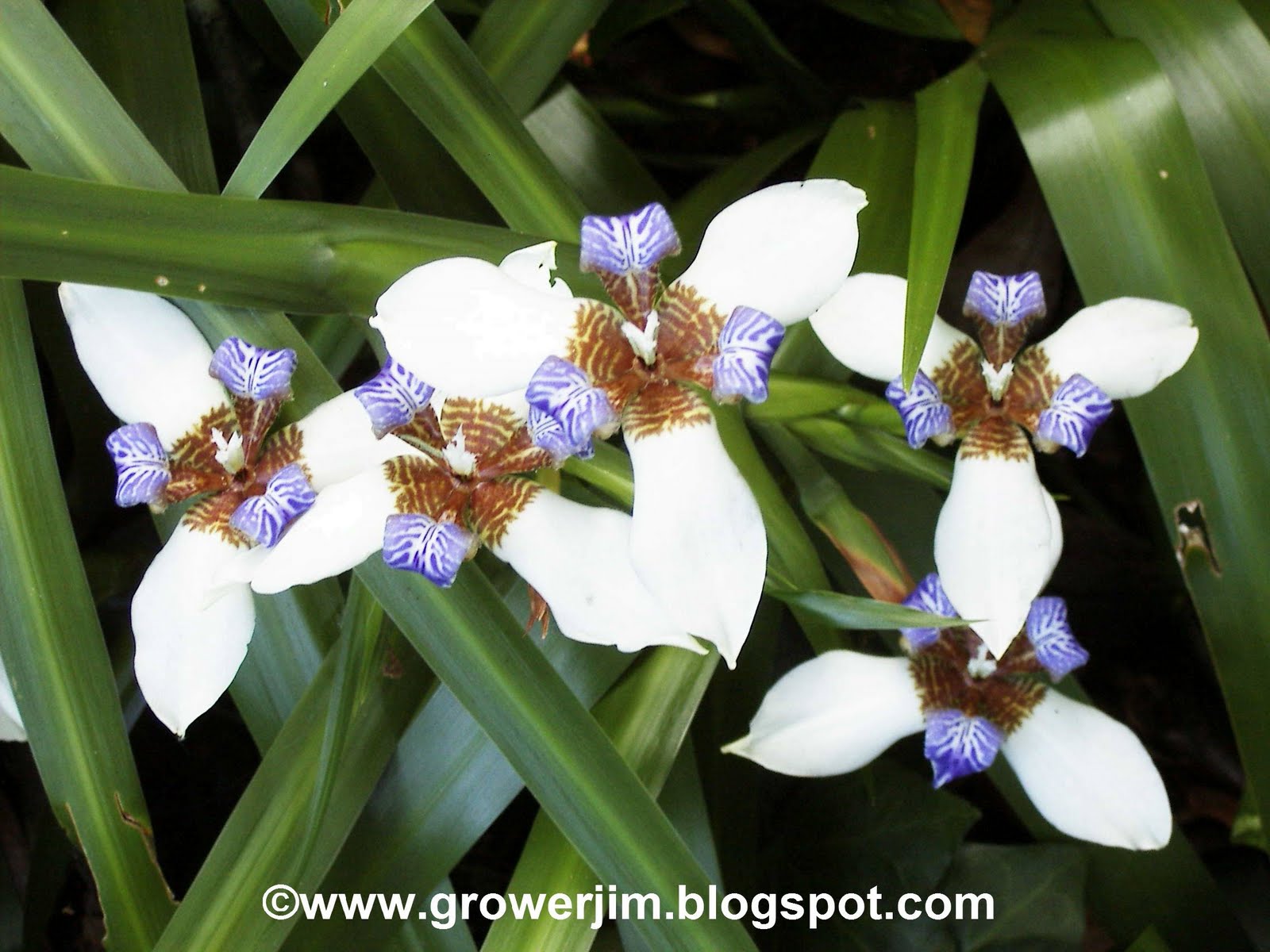
Walking Iris (Neomarica gracilis)

Walking iris is a stunning spring bloomer for warm climates.  The bright blue and white flowers are about 3 inches across.  
An entire bed of these iris will bloom on the same day and for only one day.  The spectacle is repeated every few days throughout the spring months.
After flowering, a new plant starts to form on the end of the flower stalk.
The weight of the developing plant causes the stalk to bend over and touch the ground, where the plantlet will take root. 

This is where the common name "Walking Iris" comes from.  The plants "walk" across the landscape (very slowly).  The long narrow leaves are arranged in a fan shape, typical of other members of the Iris family.  They are thin and droopy, giving mass plantings a soft billowy texture.  There is a related species with yellow flowers that has a more upright habit.
Neomarica will grow in mostly sun to full shade.  USDA Zones 8 to 11 (native to Central and South America).  The higher the zone you're in, the more shade you should give them.  Plants generally grow about 18" to 2 feet tall.  They make a nice evergreen groundcover under small trees where they'll get a little shade.

Thursday, May 20, 2010

Dewberry (Rubus trivialis)

Dewberry is a low-growing, trailing bramble that bears blackberry-like fruit.  White, five-petaled flowers appear in early spring and are followed by small fruit which are eaten by birds and small mammals.  Humans also enjoy the fruit, but due to its small size, it takes a large quantity of fruit to make a bowl full.  Fruit can be eaten fresh, or made into jams or pies if sufficient quantity can be picked.


Dewberries thrive in poor soils but reportedly fruit better when given an application of fertilizer in the fall.  The flowers and fruit appear on the vines from the previous year's growth.  The preferred exposure is sun or dappled shade.  Due to their low trailing habit, wild plants are most visible when in bloom.


The entire plant is covered with small prickles so it is necessary to wear gloves when cultivating the plant or picking the fruit.


Rubus trivialis is native to most of the southeast quadrant of the U. S.  There are several closely related species and the taxonomy of this group of plants is not completely resolved.
Some people make a tea from the dried leaves.  The fruit also yields a purple to dull blue dye.

Monday, May 17, 2010

Aechmea lamarchei

This is a large growing bromeliad that is great for landscaping.  Aechmea lamarchei grows about 3 foot tall and 4 foot wide. They tend to sprawl as they grow rather than remain an upright rosette of leaves, so give them plenty of room. Their wandering habit makes them difficult to keep confined in a pot. They nearly always grow off to one side, eventually tipping the pot and continuing to grow across the ground.

Individual plants stay in bloom for about 3 to 4 weeks, with large clumps having the bloom period spread out over a slightly longer amount of time. I have had plants bloom in spring, summer and fall, but usually several plants will come into bloom at the same time, making for a nice mass display.
Like many bromeliads, the foliage on this species changes color depending on how much light it is in.

The best color seems to be in light shade or filtered sun where it develops a light purplish-olive tint. 

In more sun, the color gets bleached out to a plain green.

They can take temperatures in the upper 20° F range without damage as long as frost doesn't settle on the leaves.

Buy Aechmea lamarchei!