Monday, April 5, 2010

Harvest Monday- 18 varieties!

Most of the things I was harvesting last month are still producing. 
In the vegetable garden I am picking turnip greens, Okinawa spinach, leaf lettuce, parsley, and peas.
The fruits I am picking now are Ruby Red grapefruit, White Marsh grapefruit, Navel oranges, Valencia oranges, Minneola tangelos, Orlando tangelos, sweet lemon, calamondin, Kumquat, Eustis limequat, Key lime, Carambola, and Glycosmis.
For photos of all the fruits, see my last two posts for Harvest Monday.
Thanks to Daphne's Dandelions for hosting the Harvest Monday meme!


Navel oranges

Sweet Lemon

Kumquat

Red grapefruit

Starfruit

Friday, April 2, 2010

21 year old seeks mate!

I'm looking for a no-strings-attached relationship for the sole purpose of creating offspring. I'm female and as you can see from my photo, I'm a quite attractive specimen.

My proper name is Laurus nobilis but my friends also know me as Bay Laurel. I've reached sexual maturity and I'm blooming for the first time but I am all alone and need a mate. Age or looks are unimportant. My only concern is if you can provide me with the children I so greatly desire.
Since this is my first time, I'm not sure how long I'll be fertile but I know it will be at least another year before I have a second chance. Time is of the essence! Even a brief encounter between us could be very productive!

You don't need to live nearby.  Your pollen could be sent through the mail!  I could even entertain multiple males at once!

If you are a male of my species and are willing and able to share some pollen, please send your contact information so we can arrange a meeting. I'm really looking forward to rubbing your anther against my stigma!

Ready and waiting,
Laurel

Friday Creature Feature - Turtle

This month's Creature Feature is a shot of a turtle passing through the back yard.  This may be one of the residents of the many burrows located on my property.

Wednesday, March 31, 2010

Mother Nature's Artistry

This edition of Mother Nature's Artistry (published the last day of every month) is a shot of the leaves of Cycas revoluta (King Sago) while they are still soft and unfurling.

Once the leaflets have flattened out, they become very rigid and prickly--a huge change from the soft texture seen in this photo!

Monday, March 29, 2010

Thinning peaches

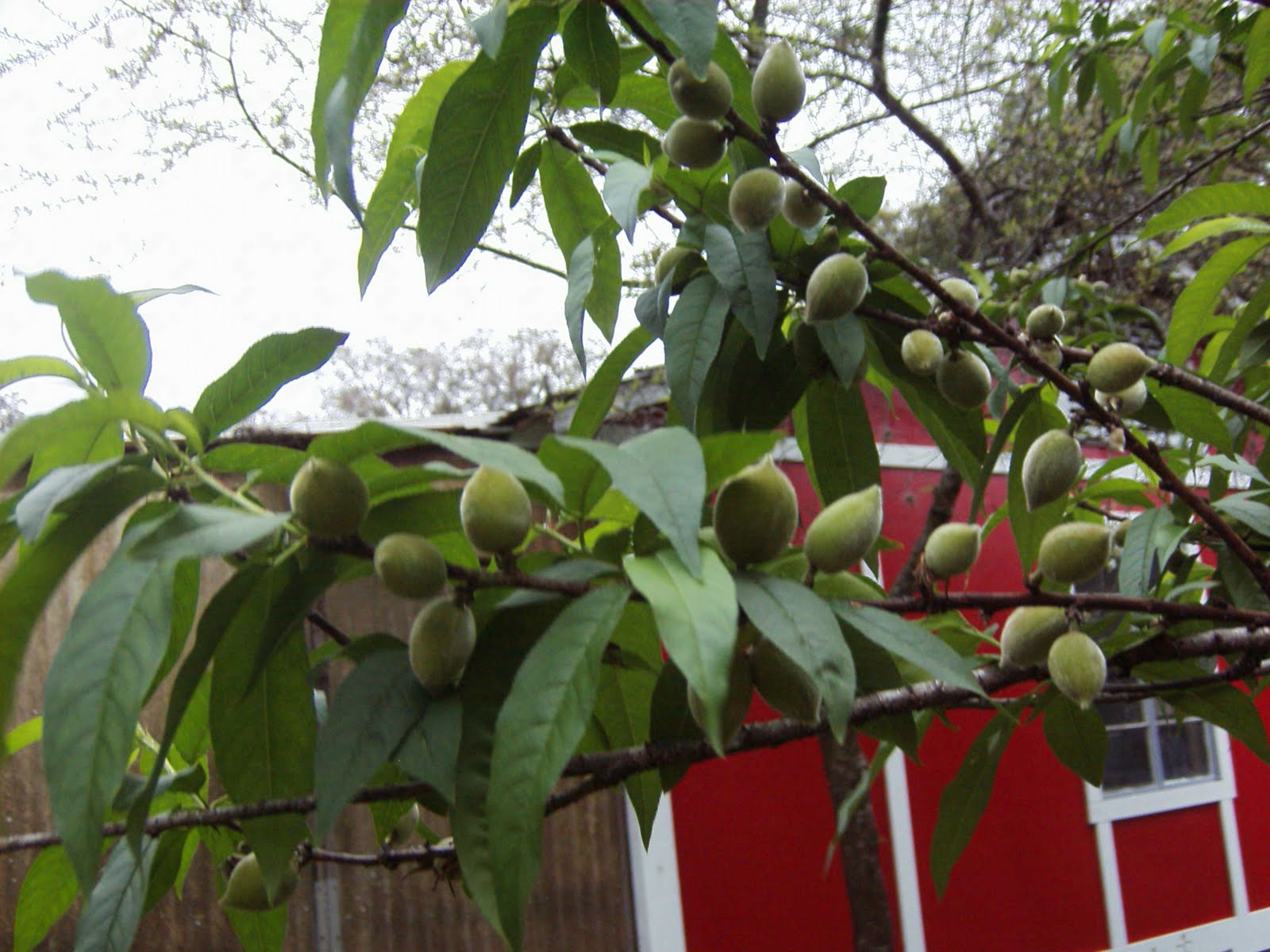
Peach trees typically set too much fruit.  Unless you thin it out, you will have lots of small fruit and not many of the nice big eating peaches.  Thinning should take place when fruit development has reached marble size up to the size of a quarter.  By then you can get a good idea of how much fruit has set and is holding on the tree. 
Thinning is performed by simply twisting or rubbing off the small fruits.  Thin the developing fruits so that you only have one fruit per 5 to 6 inches of branch.  I like the fruit I leave to be on the underside of the branch.  This makes them less visible to passing birds that might like to take a bite! 
By thinning, more of the tree's energy is available to go into fewer fruit.  The result is fewer but larger fruit--better for eating!
In the above photo you can see there are way too many fruit developing on the branches.
Below is the same branch after thinning.  The tree will put more energy into fewer fruit, resulting in big delicious peaches!

Friday, March 26, 2010

Chickasaw plum (Prunus angustifolia)

Chickasaw plum is a native of the Southeastern U.S. and they're in bloom right now in Central Florida.  Like most plums they are deciduous, and when they bloom in spring the branches are completely covered with white blossoms. 


The flowers are followed by small 1/2 to 3/4 inch diameter yellow to reddish plums that are eaten by humans and wildlife alike.  Fruits can be eaten fresh, made into jelly, or dried.


Prunus angustifolia has a tendency to sucker readily so it's not often used in formal landscaping but it's an ideal small tree for naturalized areas, background plantings, or mixed borders.  The trees grow to about 20 foot tall in USDA Zones 5 through 9. If allowed to sucker freely, it develops more of a shrubby habit.  They are very drought-tolerant once established.


The flowers are a good food source for honeybees.  Supposedly butterflies are also attracted to the blooms but in my yard they bloom before the butterfly populations have started increasing in the spring.

Tuesday, March 23, 2010

Billbergia Windii

This is one of my favorite little bromeliads:  Billbergia 'Windii'.  The plants only grow about a foot tall but the pendulous flower spike can reach nearly two feet in length!  They are great for hanging baskets or planted along a low wall where the blooms can spill over.  They multiply rapidly and individual plants will bloom at various times throughout the year.  These came through freezing temps in the mid to upper 20s F with no damage this winter so they are moving higher on my list of favorites.  They grow well in shade or filtered sun and require no additional care.  Rainfall generally provides sufficient moisture.


Here is the flower spike as it's emerging from the foliage and starting to arch over.
The above grouping is in bloom right now.  These are planted on sloping ground above the fish pond so the flowers can hang down and show themselves nicely.

The pink bracts open out to reveal the blue and green flowers inside.  What a beauty!


Here are my other posts on bromeliads

Thursday, March 18, 2010

Snag some wildlife!

A snag tree is a standing dead or nearly dead tree.  Snags are extremely valuable habitat for birds, mammals, reptiles, and amphibians.  Insects under the bark of snags provide food for woodpeckers, birds, squirrels, and other mammals.  Many birds and mammals will also use hollowed-out snags as living or nesting areas.  To really attract a wide variety of life to your property make sure to leave some dead or dying trees.  If you have no dead trees, you can create the same effect by burying large dead trunks or tree limbs in an upright position throughout your landscape.  It won't take long until the wildlife is checking it out!
The center trunk of this tree is hollow inside and no doubt harbors insects that many birds enjoy!
                                                                                   

                                                                                                                 Snags don't have to be large or take up a lot of space.  This is the trunk of a dead citrus tree.


Look closely at all the holes and you can see how many woodpeckers have been enjoying this dead Roseapple trunk!


Even a log on the ground will attract ants, beetles and other insects that lizards and other small animals will use as a food source.


Here a larger animal (maybe gopher tortoise?) has made a burrow under the trunk of a fallen live oak.


Leaving a little dead wood in your yard not only saves you the labor of removing it, but it will increase your enjoyment by attracting a variety of wildlife!
For additional tips on attracting wildlife to your yard, see: http://edis.ifas.ufl.edu/uw175

Monday, March 15, 2010

Florida Bloom Day - 33 varieties for March!

Lots of beautiful flowers are popping out this month!  Take a look...
 Above photo from upper left to lower right:  Cestrum aurantiacum, Surinam Cherry, Cherry Laurel, Peach, Oxalis, Dianthus, Petunia, Loropetalum.

Above photo from upper left to lower right:  Oncidium, vandaceous orchid, Impatiens, Shrimp plant, Formosa azalea, Red Formosa azalea, Camellia japonica, Knock-Out rose.

Above photo from upper left to lower right:  Russelia, Caesalpinia mexicana, Bush daisy, Bletilla, Kalanchoe, Brunfelsia, Spiderwort, garden pea.

Above photo clockwise from upper left:  Flatwoods plum, Ilex vomitoria, Glycosmis.
 
And then we have some bromeliads: 

Above photo upper left to lower right:  Billbergia, Aechmea apocalyptica, Quesnelia testudo, Billbergia windii, Aechmea distichantha, Vresia.

Thanks to May Dreams Gardens for hosting the monthly Garden Bloggers Bloom Day! 

Wednesday, March 10, 2010

Spiderwort (Tradescantia ohiensis)

Tradescantia ohiensis is a common wildflower that appears in many gardens.  Bright blue flowers with three petals open in the morning and wither away after a few hours. Less common colors are white, pink, and violet. Individual flowers are about an inch across. They bloom most of the year in the warmer parts of its range.  They are drought-tolerant and will grow in full sun to light shade. Leaves are long and narrow (up to 15 inches long). They have a clumping growth habit up to two foot tall.
There are several species throughout the U.S. and they readily hybridize so if you live in an area with more than one species there may be some intermediate varieties.  The flower stems of this particular species are smooth and hairless.  Tradescantia ohiensis may be found throughout the eastern half of the U.S. --USDA Zones 5-10 (or as far north as Zone 3, depending on which website you believe).
Of particular interest are the numerous, fuzzy, blue hairs on the stamens.  These mutate at a cellular level and turn pink when exposed to low levels of nuclear radiation!
(Click to enlarge)
Spiderwort is rarely bothered by insects but may be fed on by Whitetail deer, Cottontail rabbits, and box turtles. 
The Cherokee peoples used Spiderwort in a tea for digestive problems and would rub the crushed leaves on insect bites or stings.  The leaves and stems are edible fresh or cooked.  The flower petals can be candied or added to salads for interesting color.
This is a great low-maintenance perennial flower with a long bloom season, that can warn you of radiation exposure, and it's edible too!
Read the original radiation research on this plant here.